
 English
  Dutch
Dutch  German
  Spanish
 - Global Presence
- Fully Managed Solutions
- Platform-Driven Control
- Over 20 years of expertise
Remote SIM Provisioning Platform Zero-Touch Deployment for IoT and Enterprise Fleets
Weconnect's remote SIM provisioning platform gives IT and operations teams a single cloud portal to provision, monitor and control every eSIM and physical SIM profile across 195 countries and 700+ carrier networks.
- From activation to suspension to reactivation, every step happens remotely, in real time, without involving a single carrier helpdesk.
- One contract covers every activated SIM across your entire device fleet — regardless of how many locations, countries or device types are involved. One invoice, broken down by device, site or project, mapped to whatever cost structure your finance team requires.


A dedicated team with over 20 years of telecom expertise in SIM provisioning and connectivity management.

Chosen by
leading companies















Why the provisioning standard alone doesn't solve your operational problem
If you’re evaluating a remote SIM provisioning platform, you likely already know the fundamentals: eUICC chips, over-the-air profile downloads, and the basic promise of eliminating physical SIM logistics.
The question that matters at enterprise scale is different. It’s not “can I activate a profile remotely?” but “can I control 500 profiles across 30 countries from one portal, with the billing granularity my finance team requires and the security posture my CISO demands?”
That’s where most Remote SIM Provisioning implementations fall short. The underlying technology works. But the management layer on top of it, the part that handles bulk provisioning, cost center mapping, role-based permissions, automated lifecycle rules and API-driven deployment, that’s where the operational gap sits.
Weconnect’s eSIM provisioning system supports both SGP.22 and SGP.02 workflows through the same management portal. Smartphones for your sales team and embedded modules in field equipment follow the same provisioning logic, the same monitoring, the same billing structure. Where traditional SIM activation requires physical handling at every step, eSIM remote provisioning reduces the entire process to a portal action.


A cloud-based SIM management platform built around the workflows your IT team actually runs
The Connectivity Management Platform (CMP) is the operational core: a cloud-based portal where your administrators handle every aspect of eSIM and physical SIM provisioning from a single interface. As an eSIM provisioning system, it covers the full workflow from inventory management through activation to decommission.
Provision profiles in bulk or one by one. Purchase eSIM subscriptions in advance and hold them in your inventory. When a deployment needs connectivity, assign profiles to devices, generate QR codes, and distribute them through email, MDM integration, or your internal workflow. For physical SIM cards, the platform tracks your stock of 2FF, 3FF and 4FF cards with the same inventory tools.
Match plans to actual usage patterns. Static data pools share a fixed allocation across any number of SIMs at a predictable cost. Dynamic pools scale available data as you add devices. Monthly subscriptions, prepaid bundles and pay-per-megabyte billing round out the options. A project team in Southeast Asia doesn’t need the same plan structure as your permanent office in Frankfurt. The platform lets you configure each independently and adjust when requirements shift.
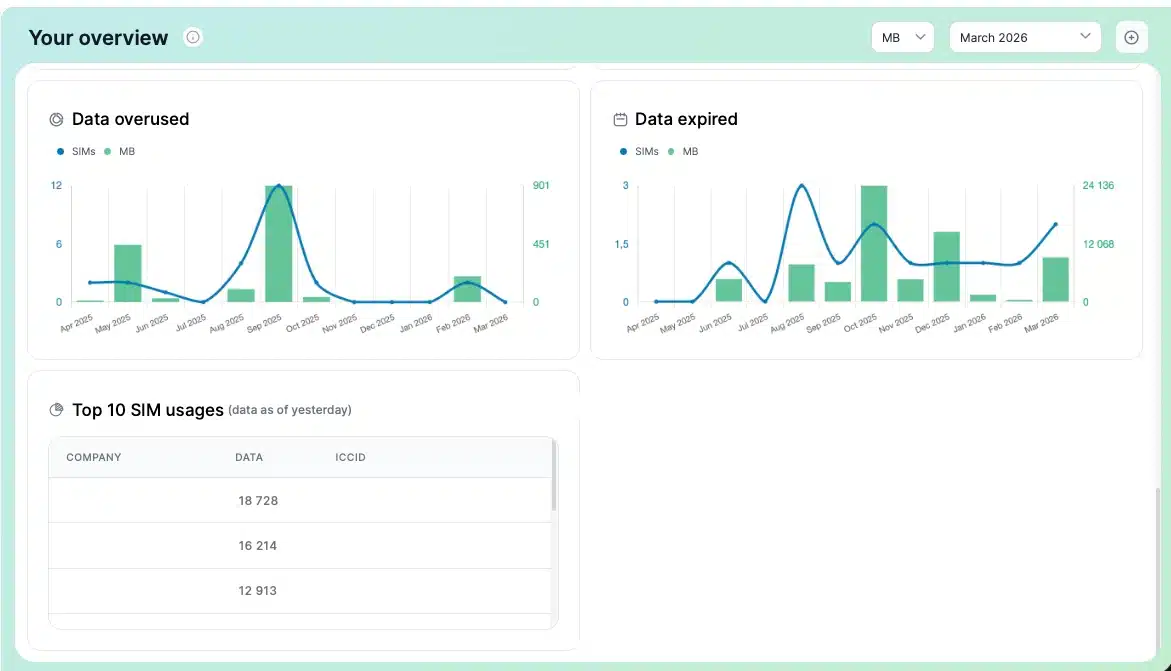
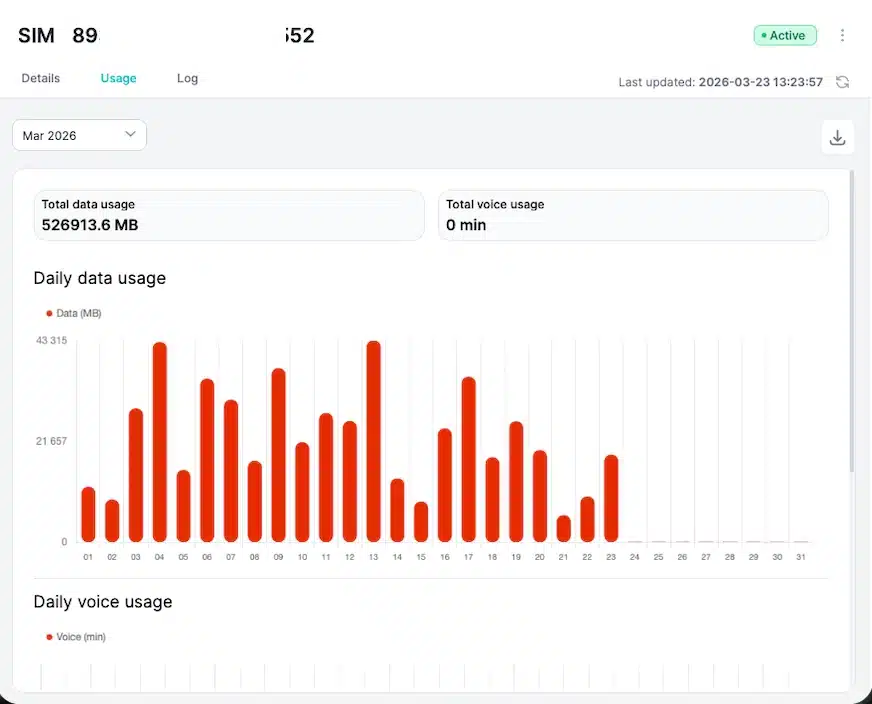
See what’s happening now, not last month. Real-time dashboards display data consumption per SIM, per user, per country as it occurs. Which profiles are active, which are nearing their data ceiling, which expired yesterday. Your IT team catches anomalies before they become invoice surprises.
Take the repetition out of SIM management. Define rules once, and the platform executes them: suspend a SIM that crosses a usage threshold, flag a plan about to expire, top up data automatically when a balance gets low. For teams managing dozens or hundreds of profiles, this is the difference between a manageable workload and a full-time administrative burden.
eSIM Lifecycle Management: From Activation to Decommission
Most eSIM software handles activation well enough. Where platforms fall short is everything that comes after. The real operational complexity sits in the middle of the lifecycle: reassignments, suspensions, plan changes, coverage expansions, and the eventual deactivation of profiles no longer in use.
Our SIM lifecycle management covers every stage:
Activation. Trigger a QR code from the portal or fire an API call from your MDM. The device pulls its eSIM profile and locks onto the strongest carrier within the assigned coverage region. Physical SIMs follow the same activation path through the portal once they’re in the field.
Active management. Change data plans without reprovisioning. Add geographic coverage regions on demand. The profile updates within minutes, no new QR code required. Reassign a profile from one employee to another when roles shift. Label and tag SIMs by department, project, cost center or any organizational logic your finance team needs.
Suspension and reactivation. A device gets lost in transit? Suspend the profile from the portal immediately. No ticket, no waiting on a carrier’s response time. When the device turns up, one click brings it back online. This applies equally to eSIM and physical SIM cards managed through the platform.
Decommission. When a project ends or an employee leaves, deactivate the profile and return the capacity to your available inventory. Every action is logged: who provisioned the profile, when it went live, how much data flowed through it, when it was retired. That record exists for every SIM in your fleet.
The gap between an enterprise SIM management platform and a consumer tool with admin features bolted on shows up here. It’s the difference between a clean audit history and a guess. Between accurate cost allocation and orphaned profiles quietly eating budget month after month.
Carrier neutral across 700+ networks in 195 countries
A remote SIM provisioning platform is only as useful as the networks it connects to. If your provisioning system ties you to a single carrier per country, you’ve replaced one operational problem with another.
A broadcast unit at a live event location can’t wait for manual network selection. A maritime router switching between territorial networks can’t rely on a single carrier. Every SIM profile provisions with automatic carrier selection built in — the strongest available signal, at every location, without IT involvement. No manual network selection, no IT intervention.
What that looks like on the ground: your field engineer at a construction site outside Lagos isn’t dependent on one carrier’s tower coverage. The device evaluates available signals and connects to the network that performs best at that location, at that moment. If conditions change, it switches.
For IT teams, multi-network provisioning means fewer connectivity tickets. For operations, it means more reliable uptime at the locations that matter most. For procurement, it means one supplier relationship replaces separate carrier contracts across every region you operate in.
When your business enters a new market, you add the coverage region through the management portal. The eSIM profile picks it up without reprovisioning.
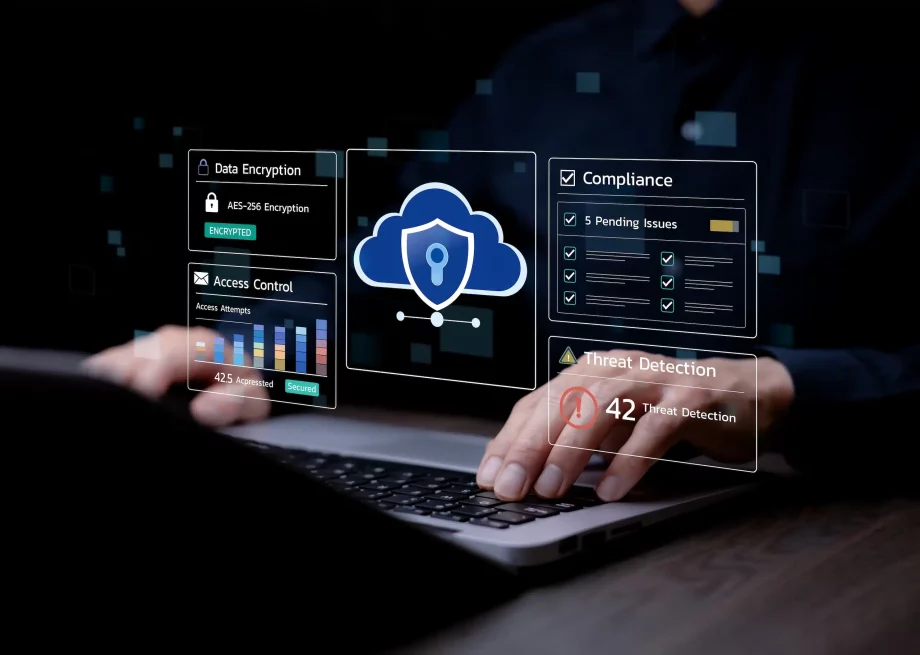
Enterprise security built into the provisioning layer
Provisioning SIM profiles remotely introduces a question every IT security team asks: who controls access, and how do we prevent misuse?
Our platform addresses this at multiple levels. Managing SIM profiles at scale means different administrators need different levels of access — a regional IT lead managing devices in their geography, a partner managing their own customer accounts, a finance team pulling billing reports. Role-based access scopes every administrator to their own environment, with no visibility into accounts or devices outside their defined scope.
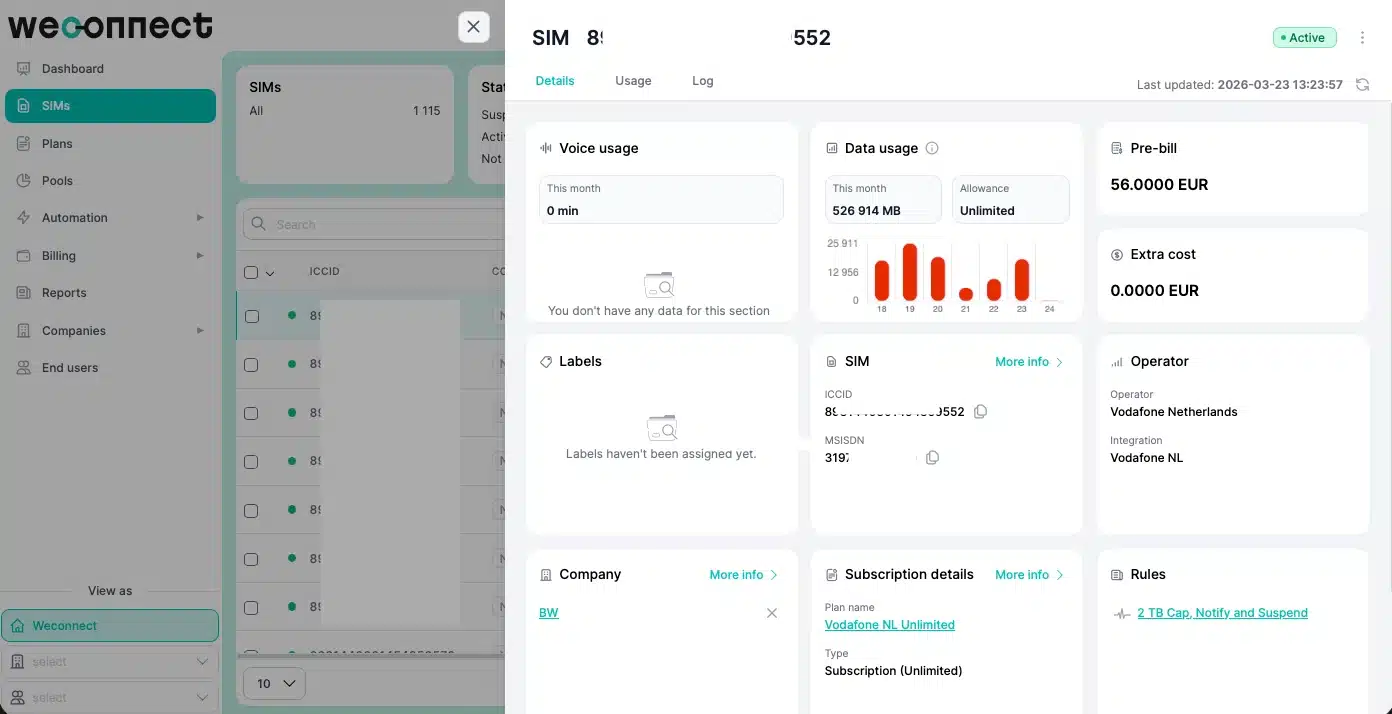
Every provisioning action is logged: which profile was activated, on which device, by whom, and when. Whether you operate in a regulated industry or simply need to track who changed what across a large device fleet, that audit trail is available for every SIM in the platform — without filing a support ticket to retrieve it. A project manager sees their team’s usage. Nobody sees what falls outside their defined scope, and every action they take is written to an immutable audit log.
Device-level controls go further. IMEI locking binds each eSIM profile to one specific piece of hardware. Remove the profile and try to load it on a different device, and it refuses to connect. Dedicated APNs route corporate data traffic off the public internet entirely, directing it through your own secured infrastructure.
Organizations that need encrypted data paths from device to data center can enable IPsec VPN integration. Webhooks secured with SHA256 HMAC deliver real-time event data to your internal systems through a channel that’s cryptographically verified against tampering. Portal access itself sits behind two-factor authentication, and staff permissions can be set at the level of individual modules.
None of this is an upgrade tier or a paid add-on. It’s part of the standard platform.
eSIM Software that integrates with your existing systems
A SIM management platform that operates in isolation creates another silo. Our platform exposes RESTful APIs that give you programmatic control over the full eSIM lifecycle: provisioning, suspension, reactivation, usage queries, billing exports and inventory management.
Those APIs connect to the MDM platforms most enterprise IT teams already run. Jamf, Microsoft Intune, VMware Workspace ONE: the integration means SIM provisioning slots into your existing device enrollment and management workflows instead of running as a separate process with its own login and its own logic.
On the finance side, the platform integrates with invoicing systems like Xero and WeFact. Billing data maps to cost centers, departments or projects in whatever structure matches your existing allocation model. No rekeying charges into a spreadsheet at month end.
Event-driven webhooks push status updates, usage alerts and automation triggers directly into your monitoring stack, ticketing system or custom dashboards as they happen. You receive the API documentation when your account is set up, and our technical team walks through integration questions during onboarding and beyond.
Physical SIM and eSIM: One SIM Management solution for both
Maritime vessels run routers and communication equipment that require embedded MFF2 SIMs — hardware installed for the lifetime of the vessel, not swapped at port. Broadcast production trucks carry encoders and transmission equipment with physical SIM slots alongside modern laptops and tablets that support eSIM. Telecom partners deploying CPE routers across retail chains manage thousands of fixed devices that will never support over-the-air provisioning.
The platform provisions and monitors every form factor through the same portal: MFF2 chips soldered directly to hardware, physical 2FF/3FF/4FF cards in fixed equipment, and eSIM profiles for devices that support remote provisioning. One management interface, one invoice, regardless of what the hardware requires.
Our platform manages both formats through the same interface. eSIM-capable devices receive profiles via QR code, activated over the air. Devices requiring physical cards are supported in 2FF, 3FF and 4FF format. Both types share the same monitoring, the same cost controls, the same reporting and the same automation rules.
For organizations running dual-SIM configurations, the platform tracks both usage streams independently. You migrate to eSIM at whatever pace matches your device refresh cycle, without losing visibility or control in the meantime.


Bootstrap eSIM and LPA Codes: Zero-Touch Provisioning for IoT
QR code provisioning works when there’s a person holding a phone. But a GPS tracker bolted to a shipping container doesn’t have a screen. Neither does a smart meter, an industrial sensor, or a router deployed inside a sealed enclosure. For these devices, remote SIM provisioning needs to work without any user interaction at all.
That’s the role of the bootstrap eSIM. It’s a pre-installed profile on the device’s eUICC that establishes network connectivity the moment the device powers on. No scanning, no app, no manual setup. Once online, the device uses its LPA code (LPA:1$SM-DP+address$ActivationCode) to reach the SM-DP+ server, download the operational carrier profile, and switch to it — without any manual step in between.
For your production and logistics team, this means one global SKU across all markets. Trackers shipping to a logistics hub in São Paulo come off the same line as units going to a warehouse outside Rotterdam. Where they end up determines which profile they pull. Nothing else changes.
We supply bootstrap eSIM profiles with LPA codes configured for your specific SM-DP+ environment and deployment scale — whether you’re activating a pilot batch of ten devices or rolling out across ten thousand endpoints.
A SIM Management Platform built for enterprise, not consumer convenience
The market for eSIM software has grown quickly, and most of what’s available started as a consumer product. A travel app where individuals buy data bundles, with an admin dashboard added later for corporate accounts. That architecture shows its limits the moment you need bulk provisioning for 200 devices, composite billing across four subsidiaries, or API-driven deployment through your existing IT workflows.
Our Connectivity Management Platform was designed for enterprise operations from day one. The organizational structure mirrors how businesses actually work: a hierarchy of Organization → Company → End User, with role-based permissions at every level. Billing is built around cost center mapping, not individual top-ups. Automation rules handle the repetitive work that would otherwise land on your IT team’s desk.
That’s the practical difference between eSIM software built for enterprise and a consumer product with corporate features added on.

How it works: From first contact to full deployment
Step 1 — Scoping. We map your provisioning requirements: number of users and devices, geographic coverage, data consumption patterns, security requirements, and integration points with your existing IT stack.
Step 2 — Platform setup. We configure your management portal with your organizational hierarchy, admin roles, billing preferences and automation rules. Your IT team receives training and full API documentation.
Step 3 — Pilot. Deploy to a defined group across your key markets. Validate network performance, confirm security configurations, test API integrations. Our technical team supports you throughout.
Step 4 — Rollout. Scale to your full organization using bulk provisioning tools or API-driven deployment. eSIM profiles deploy via QR code, distributed through email or your existing device management workflow. Physical SIMs are shipped to your designated locations with tracking through the platform.
Frequently asked questions
A remote SIM provisioning platform allows organizations to deliver, activate and manage SIM profiles over the air, without physical SIM cards or carrier coordination. For enterprises, this means IT teams can provision connectivity to any device, in any country, from a single cloud portal. Weconnect’s platform adds enterprise-grade features on top of Remote SIM Provisioning technology: bulk provisioning, lifecycle management, role-based access, composite billing and API integration.
Traditional activation requires ordering a physical card from a carrier, shipping it to the right location, inserting it, and activating it through a carrier portal. Remote provisioning delivers the profile over the air to the device’s eUICC chip, activated through the management platform, and connected within minutes. For enterprises operating across multiple countries, this collapses deployment timelines from weeks to hours.
Yes. eSIM profiles are delivered via QR code. Physical SIM cards in 2FF, 3FF and 4FF format are managed through the same portal with the same monitoring, cost controls, automation rules and reporting. Most of our enterprise customers run hybrid deployments during their transition to eSIM-compatible hardware.
Every provisioned profile connects to multiple carrier networks per country. Adding a new coverage region happens through the portal; the profile updates without reprovisioning. As a centralized SIM management solution, the platform handles lifecycle management for eSIM and physical SIM identically: suspension, reactivation, plan changes and decommission are all controlled from one portal, regardless of where the device is located.
Access control is role-based and scoped per module. Devices are protected through IMEI locking. Data traffic routes through dedicated APNs, off the public internet. Portal access requires two-factor authentication. All administrative actions are written to an audit log. Webhooks use SHA256 HMAC for cryptographic verification. IPsec VPN integration is available for encrypted device-to-datacenter paths.
RESTful APIs connect to Jamf, Microsoft Intune, VMware Workspace ONE and other major MDM platforms. SIM provisioning plugs into your existing device enrollment and management process. Documentation ships with your account, and our technical team is available for integration support.
Single profiles go live within minutes via QR code. Bulk deployments run through the platform’s inventory management tools or API. In pilot phases, most organizations activate their first profiles the same day the platform is configured.
Suspend the profile from the portal immediately. IMEI locking prevents the profile from working on any other hardware. If the device comes back, reactivation takes one action in the portal.
No fixed minimum. The platform works for a project team of 10 and for a global deployment of thousands. Features, security controls and reporting are the same at every scale.
A bootstrap profile is a stripped-down, pre-installed profile on the device’s eUICC. It does one thing: get the device online so it can reach the SM-DP+ server. Once there, it downloads the operational carrier profile – the profile the device runs on from that point forward. In deployments where no one is on-site to scan a QR code or interact with the device, this two-step sequence is what holds the process together: the bootstrap profile handles the connection, the LPA code handles the profile selection.
The LPA code is the string that tells the device which profile to download and from which server. Without it, the device has no way of knowing where to go after the bootstrap connection is established.
Any device with an eUICC module that conforms to GSMA SGP.22 or SGP.32 – industrial routers, smart meters, vehicle trackers, environmental sensors. A screen or local user interface is not part of the equation. Bootstrap activation exists precisely because these devices don’t have one.
Yes, and it’s the practical reason most high-volume IoT deployments use it. One global SKU, shipped anywhere. Each device powers on, uses the bootstrap profile to reach the SM-DP+ server, and pulls its operational profile. The Connectivity Management Platform logs every activation centrally – location of the device doesn’t factor into that.
Stop managing SIM cards. Start provisioning them remotely.
Direct response in 60 minutes
Weconnect is an independent Global Managed Connectivity Provider, headquartered in Alkmaar, the Netherlands. With over 20 years of telecommunications expertise, our platform serves organizations including RTL, DHL, Hertz, Fugro and DFDS across 195 countries. Send an e-mail to [email protected] or call us on +31 20 237 3300.
- Direct response within 1 hour
- Dedicated specialist providing one-on-one guidance
- Obligation-free cost comparison against your current spend
- No hidden fees and no minimum commitment to get started
- Trusted by RTL, DHL, Fugro and DFDS for mission-critical connectivity
Direct response within 1 hour.
