
 English
  Dutch
Dutch  German
  Spanish
 - Global Presence
- Fully Managed Solutions
- Platform-Driven Control
- Over 20 years of expertise
Enterprise eSIM management Manage global business connectivity from one Platform
Provision, monitor and control all business eSIMs across your organization. 700+ carrier networks in 195 countries managed through one portal with real-time visibility, composite billing and full API access.
- Non-steered technology connects every device to the strongest available carrier.
- Define data budgets per user, department, region or project - alerts before limits reached.
- Instant QR code deployment: no SIM cards to ship, no devices to configure manually.
- Composite billing with cost center mapping - one invoice, every country, every user.


A passionate team with more than
20 years of expertise in enterprise connectivity management
Chosen by
leading companies















Managing global connectivity shouldn't require ten carrier contracts and a spreadsheet
Most enterprises still manage international mobile connectivity the way they did a decade ago. Separate contracts per country. Different portals per carrier. Invoices arriving in multiple currencies from different providers, often weeks after the usage occurred.
IT has no real-time visibility. Finance can’t allocate costs accurately. And when a device goes missing in São Paulo on a Friday evening, there is no single dashboard to suspend it from.
The operational cost of this fragmented approach goes well beyond roaming charges. It’s the hours your IT team spends coordinating with regional carriers. It’s the procurement cycles every time you enter a new market. It’s the security risk of employees connecting through unmanaged networks because their corporate SIM simply doesn’t work in that country.
We built our enterprise eSIM management platform to eliminate exactly this. One portal. One contract. One invoice. Every country, every device, every department – visible and controllable in real time.

700+ carrier networks across 195 countries - managed from one eSIM management platform
Traditional enterprise SIM programs lock you into single-carrier agreements per region. When that carrier has poor coverage at a specific location, your team loses connectivity. Adding a second carrier means another contract, another integration, another invoice.
Our enterprise eSIM management platform takes a different approach. Every eSIM profile connects to multiple carriers per country through non-steered multi-network technology. The device automatically selects the strongest available signal – no manual network selection, no IT intervention required.
For IT teams this means fewer support tickets about connectivity issues.
Operations teams get stable data connections at remote sites, construction locations and industrial zones – the kind of places where relying on a single carrier leaves you without signal.
The procurement benefit is straightforward: one supplier relationship replaces regional carrier contracts across 195 countries.
Technical specification: The eSIM supports 2G, 3G, 4G and LTE globally, with 5G available in a majority of countries. Devices connect to the strongest available carrier network in each country – no steering, no preferred-carrier lock-in.
Full visibility and control across every eSIM subscription in your organization
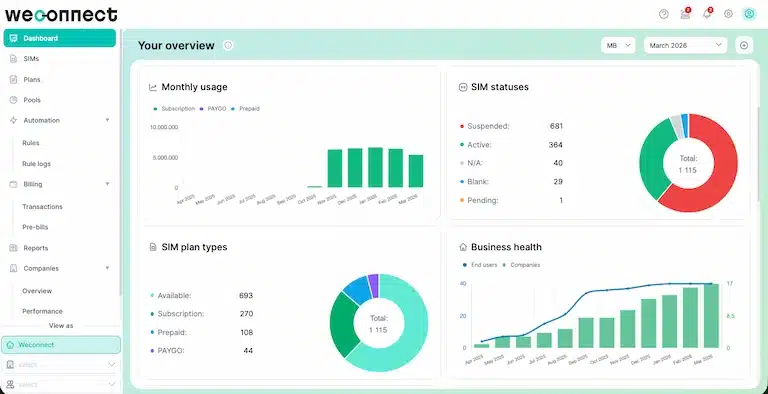
The core of our enterprise eSIM management solution is the Connectivity Management Platform: a cloud-based portal where your IT and finance teams manage every connection from a single interface.
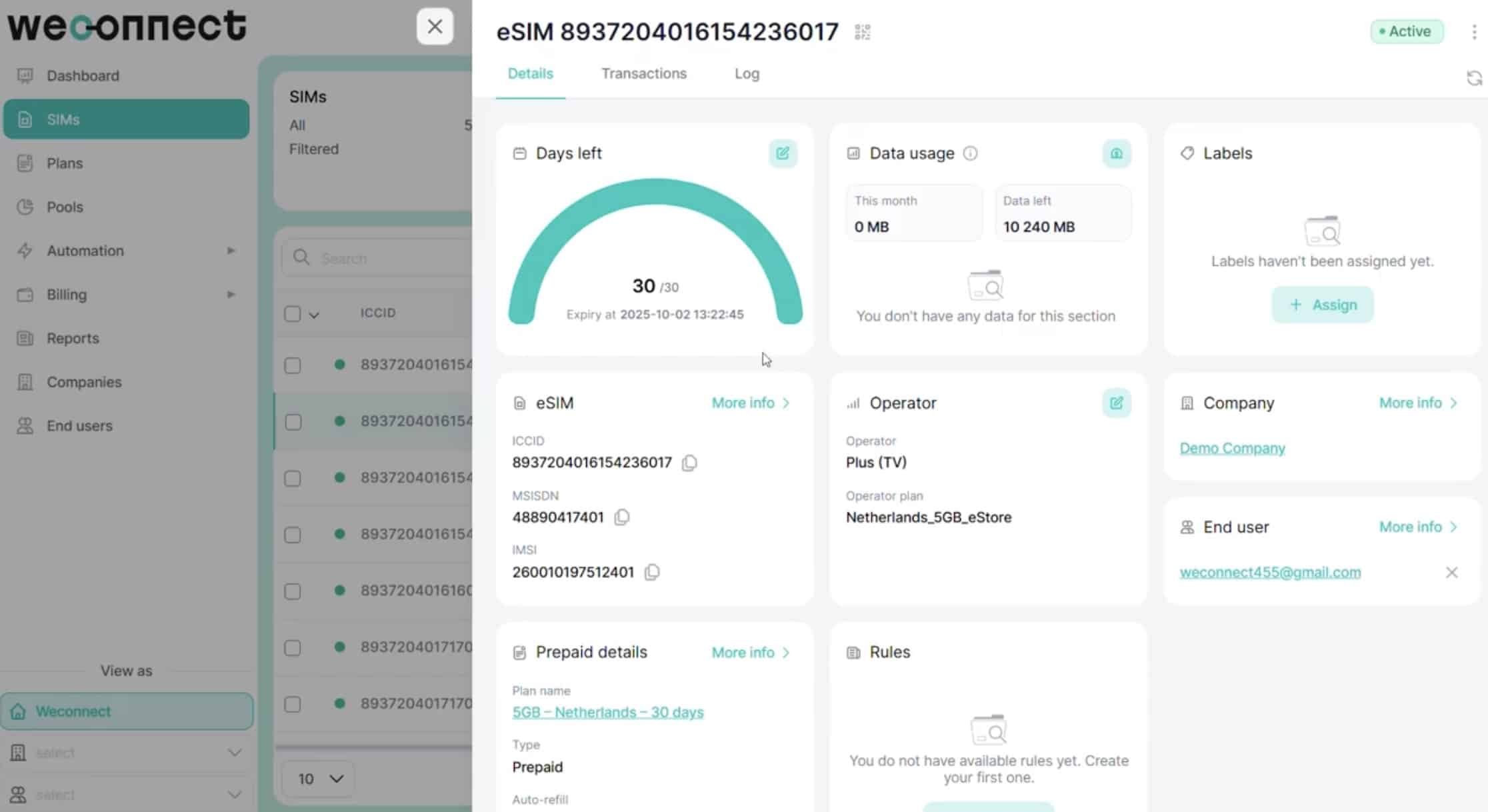
You see data consumption per device, per user, per region as it happens, not when the billing cycle closes a month later. When a subscription approaches its data limit, the platform notifies you automatically. You can pause or reactivate any eSIM profile on the spot. No ticket to submit. No carrier helpdesk to call.
The account structure mirrors your organization. Role-based access control means each administrator sees exactly what they need to see and nothing more. IT keeps full oversight across the company. Finance receives composite billing with charges mapped directly to cost centres, departments or projects, structured for allocation rather than manual reconciliation.
Bulk provisioning and inventory management let you purchase eSIM subscriptions in advance and distribute them as needed across your organization. Real-time dashboards show your purchased, active, available and expiring inventory at a glance. Automation rules handle the routine: suspend inactive profiles, trigger alerts when thresholds are reached, refill plans automatically.
Where most eSIM providers give you a consumer app with an admin panel bolted on, our platform was built for enterprise operations from day one. That difference shows in the workflow automation, the billing granularity, and the API access that lets you integrate eSIM management into your existing systems.


The business case goes beyond roaming: fewer vendors, less admin, more control
The most visible saving is on roaming costs and the numbers are substantial. Traditional operators still charge €2.50 per MB in countries like the UAE. That means 1 GB of data would run €2,500. Through our platform, that same gigabyte ranges between €3,00 and €6,00. Scale that difference across an international team and the financial case is self-evident.
But for larger organizations, the operational savings often exceed the direct cost reduction.
Vendor consolidation means replacing multiple regional carrier contracts with a single agreement. One negotiation cycle, one SLA, one escalation path. The administrative overhead of managing separate carrier relationships per country disappears entirely.
IT efficiency improves the moment you stop shipping physical SIMs between offices, managing inventory in spreadsheets, or walking employees through manual device setup. QR code provisioning replaces all of that what previously took days of logistics is handled remotely, instantly.
Financial visibility is a direct result of composite billing with cost center mapping. Finance teams receive one consolidated invoice covering all countries, all users, all usage – broken down by employee, department, region and time period. Monthly closing becomes faster because connectivity costs are pre-allocated, not reconstructed from a pile of carrier invoices.
Security and compliance improve because every device connects through enterprise-controlled infrastructure with dedicated APNs, not through unknown local networks. When a device is lost or compromised, one action in the management portal suspends it globally – no phone call required.
Hybrid fleet management: eSIM and physical SIM from one platform
Not every device in a global fleet supports eSIM. Industrial handhelds, legacy field equipment, older company phones – they all need connectivity too. Our platform handles both formats through the same interface.
eSIM-compatible devices receive their profiles via QR code over the air. Devices that still require a physical card are supported in standard 2FF, 3FF or 4FF format. Both types are managed, monitored and controlled from the same portal with identical cost controls and reporting.
You migrate to eSIM at whatever pace matches your device refresh cycle. For organizations running dual-SIM configurations – keeping a primary corporate voice SIM alongside a Weconnect eSIM for international data – the platform tracks both usage streams independently. No need to run two separate management systems in the meantime.


Built for your existing IT stack
Enterprise eSIM management only works if it connects to the tools your teams already use. Our platform provides RESTful APIs for programmatic control over every aspect of the eSIM lifecycle: provisioning, suspension, reactivation, usage queries and billing data.
The API enables integration with your existing device management and HR systems. Push eSIM profiles as part of your standard device enrollment workflow. When a new employee is onboarded, the eSIM profile can be provisioned through an API call before the travel booking is even confirmed.
Billing and expense systems receive structured usage data via API or scheduled exports, mapped to the same cost centers your ERP already uses. We integrate with invoicing platforms including WeFact and Xero, with webhook support for custom billing workflows.
Security infrastructure is built in. The platform supports dedicated APN configurations for network-level traffic isolation, fixed IP addresses for accessing corporate resources remotely, and IMEI locking to tie eSIM profiles to specific hardware. Administrative actions are logged for audit purposes, and access is controlled through role-based permissions at module level. All data handling follows GDPR standards.
Secure webhooks use SHA256 HMAC for all Push API event delivery.
Enterprise eSIM management platform:
technical specifications
- Global network infrastructure:
- 700+ carrier partnerships across 195 countries.
- Non-steered multi-network access per country.
- Automatic network selection based on signal strength and quality.
- 2G/3G/4G/LTE globally, 5G in select markets
- Device compatibility:
- All eSIM-capable smartphones, tablets and IoT devices.
- Physical SIM support (2FF/3FF/4FF) for legacy devices.
- Dual-SIM configurations (eSIM + physical SIM) .
- iOS, Android and embedded IoT operating systems.
- iOS & Android certified.
- Platform capabilities:
- Cloud-based management platform (CMP) with role-based access
- Hierarchical account structures with organizational and company level management.
- Real-time usage monitoring with custom alerts.
- Data limits configurable per subscription, user, department or project.
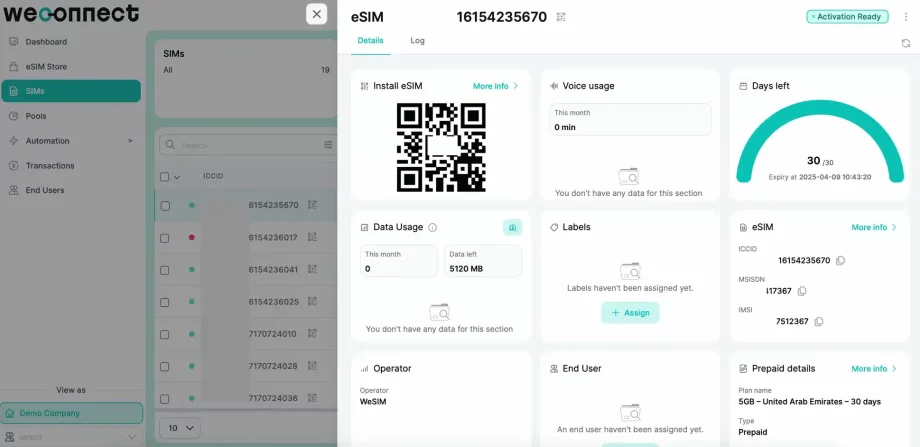
- QR code generation for eSIM provisioning.
- Composite billing with cost center mapping.
- Bulk provisioning and inventory management.
- Automation rules (triggers, actions, notifications).
- RESTful API for full programmatic management.
- Webhook support (SHA256 HMAC secured).
- SMS messaging to SIM cards.
- Flexibility & commercial:
- Regional subscription bundles (Europe, Asia-Pacific, Americas, Global).
- Shared data pools - static and dynamic - across user groups.
- On-demand region additions without reprovisioning.
- Prepaid, subscription and pay-per-MB billing models.
- Monthly or quarterly billing cycles.
- No minimum commitment contracts.
- Custom profiles, so access only within the countries needed for your company operations.
- Security:
- Dedicated APN support IMEI locking (device-level binding).
- Two-factor authentication (2FA).
- Role-based access control with per-module permissions.
- Granular staff permissions (add/edit/delete on modules).
- Audit logging of all administrative actions.
- Secure webhooks (SHA256 HMAC).
- GDPR-compliant data handling.
How organizations use our eSIM management platform
Enterprise & Corporate Operations – Most international teams end up with the same problem: connectivity that works at headquarters and falls apart the moment someone lands in a different country. Local SIM purchases, roaming charges that surface weeks later, no central visibility into who’s using what. The platform gives IT one place to manage every device, every country, without building a separate carrier relationship each time the business moves into new territory.
Energy & renewables – Operations teams managing field engineers across wind farms, solar installations and grid projects in multiple countries need connectivity that works without per-country carrier contracts. Non-steered access to multiple carriers per country means engineers stay online at remote locations where a single network simply doesn’t cover.
Oil & gas – Facility managers need connectivity at rigs and remote installations ready before crews fly in. When a rotation team arrives from multiple countries, their eSIM profiles are already active. IMEI locking meet the sector’s strict security requirements.
Manufacturing & industry – IT departments supporting technicians traveling between global production facilities manage connectivity across multiple countries from one platform. Automation rules suspend unused eSIMs after project completion and reactivate them for the next deployment. Avoid the Risks of Public Wi-Fi Public Wi-Fi is inherently insecure and exposes business data to interception and cyber threats. Weconnect provides a secure mobile connectivity alternative for teams working anywhere.
Broadcasting & media – Production teams deploying to international events need instant, reliable data for live feeds, uploads and coordination. The platform lets operations provision eSIM profiles rapidly for event crews, then deactivate them when the broadcast wraps.
Engineering & construction – Project managers coordinating international job sites where teams work for weeks or months at a time. Data pooling across project teams keeps costs predictable. Physical SIM support covers ruggedized field devices that do not support eSIM.
Maritime & shipping – Fleet managers keeping vessels connected as they cross territorial waters and switch between national networks. The platform tracks usage by vessel and crew, replacing the patchwork of local SIM purchases at every port call.

From evaluation to operational deployment in 24 hours
Step 1 – Scoping call (30 minutes). We map your connectivity requirements: number of devices, geographic coverage, data usage profiles, security policies and integration needs. You receive a deployment recommendation with transparent pricing – no back-and-forth with sales.
Step 2 – Platform configuration (1–2 hours). We set up your management portal with organizational hierarchy, admin roles, billing preferences and any automation rules. Your IT team receives hands-on training and full API documentation.
Step 3 – Pilot (1–2 weeks). Deploy to a defined group across your key markets. Validate network performance, confirm security configurations, test API integrations. Our technical team supports you throughout.
Step 4 – Rollout. Scale to your full organization using bulk provisioning tools or API-driven deployment. eSIM profiles deploy via QR code – distributed through email or your existing device management workflow. We provide dedicated support during rollout.
Frequently asked questions
Think of it as moving SIM card management off a spreadsheet and into a proper system. Rather than dealing with separate contracts, portals and invoices per country, everything – profiles, data limits, billing, user access – sits in one place. IT can provision a device remotely without touching it, suspend a profile if something goes wrong, and pull usage reports without calling a carrier. Finance sees costs broken down by department or cost center, not as a lump sum from six different providers. The main shift for IT teams isn’t the technology itself – it’s the reduction in back-and-forth: fewer tickets, fewer carrier contacts, fewer manual steps per device.
Standard carrier contracts give you connectivity. An eSIM management platform gives you control. With traditional carrier arrangements, you manage separate agreements per region, receive fragmented billing, and have limited real-time visibility into usage. Our platform consolidates all of this: one contract covering 195 countries, one composite invoice mapped to your cost centers, and real-time monitoring across every device in your fleet. The platform also enables automation – setting data limits, triggering alerts, suspending profiles – without contacting a carrier helpdesk.
Devices connect to the same infrastructure local subscribers use. Speeds reflect that: what you get is a local SIM experience, not a visitor on a foreign network. The platform isn’t tied to one carrier per country. When a network underperforms at a specific location – and they do, coverage maps are optimistic by nature – the device connects to whichever carrier has the stronger signal there. For field teams in regions where infrastructure is uneven, that redundancy is the difference between working and waiting.
Cellular connectivity provides a fundamentally more secure communication channel than public Wi-Fi for example. Data traffic runs over operator-managed mobile network infrastructure with built-in authentication and encryption mechanisms, significantly reducing exposure to interception, rogue access points or unsecured hotspots. For additional control, each eSIM profile can be locked to a specific device via its IMEI. If the profile is inserted into another handset, it will not register on the network. Within the management platform, administrative actions are fully logged and access rights can be defined with granular, module-level permissions. All data handling and processing is performed in accordance with GDPR requirements.
Yes. The platform supports granular policies by job title, department, region, project or any combination. Executives might get unrestricted global access while field contractors receive capped regional bundles. Policies adjust in real time through the portal – no support ticket needed.
Yes. The API covers what you’d expect: provisioning, suspension, reactivation, usage queries, billing exports. Webhooks run SHA256 HMAC authentication, so incoming events can be verified as genuine on your end. The practical upside is that eSIM activation stops being its own separate task – it fits inside your existing enrollment flow. Documentation is included and we work through the setup with your team.
Every customer receives one consolidated invoice covering all countries, all users, all usage. Charges break down by employee, department, cost center, region and time period. Invoices are delivered in your preferred currency on your billing cycle. Real-time usage data is also accessible through the platform at any time.
The profile is registered to that device’s IMEI at activation. Put it in a different phone and it won’t connect – there’s nothing to unlock or transfer. Suspension from the management portal cuts access immediately. If you need to reissue a profile to a replacement device, that’s done in minutes from the same portal.
We encourage it. Most pilots run with a small group of users across your primary markets for approximately two weeks. You validate network performance, security configurations and platform integration while our technical team provides dedicated support. There is no commitment required during the pilot.
You add it yourself through the management portal. The eSIM profile picks up the new coverage without reprovisioning. It typically takes effect within minutes.
A lot of enterprise fleets are in exactly this position – newer smartphones sitting alongside ruggedized field devices, IoT hardware or older handsets that still need a physical SIM. We supply both formats, and both run through the same platform. Same monitoring, same cost controls, same reporting. There’s no separate system to maintain while you work through your device refresh cycle.
In most deployments, the Business eSIM profile (installed via QR code) is simply added to the second SIM slot of the device, while the existing physical SIM remains active. This allows organizations to introduce eSIM connectivity without disrupting current mobile setups.
As devices are gradually refreshed, companies often phase out physical SIMs over time rather than switching everything at once. Because both SIM formats are managed identically within the platform, the transition happens smoothly without operational impact. The benefits – such as eliminating physical SIM logistics and enabling instant deployment – typically become visible early in the process.
Ready to centralize your eSIM management?
Direct response in 60 minutes
Our enterprise connectivity specialists will map your requirements and provide a deployment proposal based on your actual infrastructure. No generic sales process – a direct conversation about your technical environment and how the platform addresses it. Send an e-mail to [email protected] or call us on +31 20 237 3300.
- Direct response within 1 hour
- Dedicated specialist providing one-on-one guidance
- Obligation-free platform demo
- Custom proposal matching your organization's exact requirements
- NO hidden fees or surprise charges
- Trusted by industry-leading companies worldwide
Direct response within 1 hour.
